Portugal is improving. But still far behind Europe.
The latest Special Eurobarometer 574 on Sport and Physical Activity, published by the European Commission in September 2026, shows a positive evolution in the physical activity habits of Europeans.
In the European Union, the percentage of citizens who say they never exercise or play sports dropped from 45% in 2022 to 39% in 2026. At the same time, 38% say they exercise several times a week and 9% almost daily.
Portugal follows this trend but starts from a quite different reality.
In 2022, 73% of Portuguese said they never exercise or play sports. In 2026, that figure fell to 68%, while exercising several times a week increased from 18% to 24%.
There is improvement, but the gap with the rest of Europe remains significant. Portugal has the highest percentage in the European Union of people who say they never exercise or play sports, followed by Romania with 66% and Greece with 65%.
At the other extreme, we find countries where exercise is part of the routine for a much larger portion of the population. In Finland, 21% of respondents say they exercise daily and another 59% several times a week. In Denmark, the figures are 20% and 59%, respectively.
The Portuguese reality is therefore not inevitable. And more than just noting the gap separating us from the most active countries, it is important to understand what might be hindering the transition from intention to practice.
If we know the benefits, why do we still not train?
The data reveal an interesting contradiction.
98% of Portuguese acknowledge the contribution of sport and physical activity to mental health. Yet, 68% say they never exercise or play sports.
In other words, recognizing the benefits does not necessarily mean being able to turn them into a habit.
The barriers cited by the Portuguese help explain this difference: 39% mention lack of motivation and 31% lack of time, due to professional, school, or family responsibilities.
And this is precisely where these numbers become more than just a snapshot of Portuguese habits and become particularly relevant for gyms, clubs, personal trainers, studios and other professionals in the sector.
The fitness challenge may be less about convincing and more about facilitating
If a large part of the population already recognizes that physical activity is important, perhaps the next step for the sector is not just to continue explaining why we should train.
It might be necessary to understand what is preventing people from starting and, above all, from continuing.
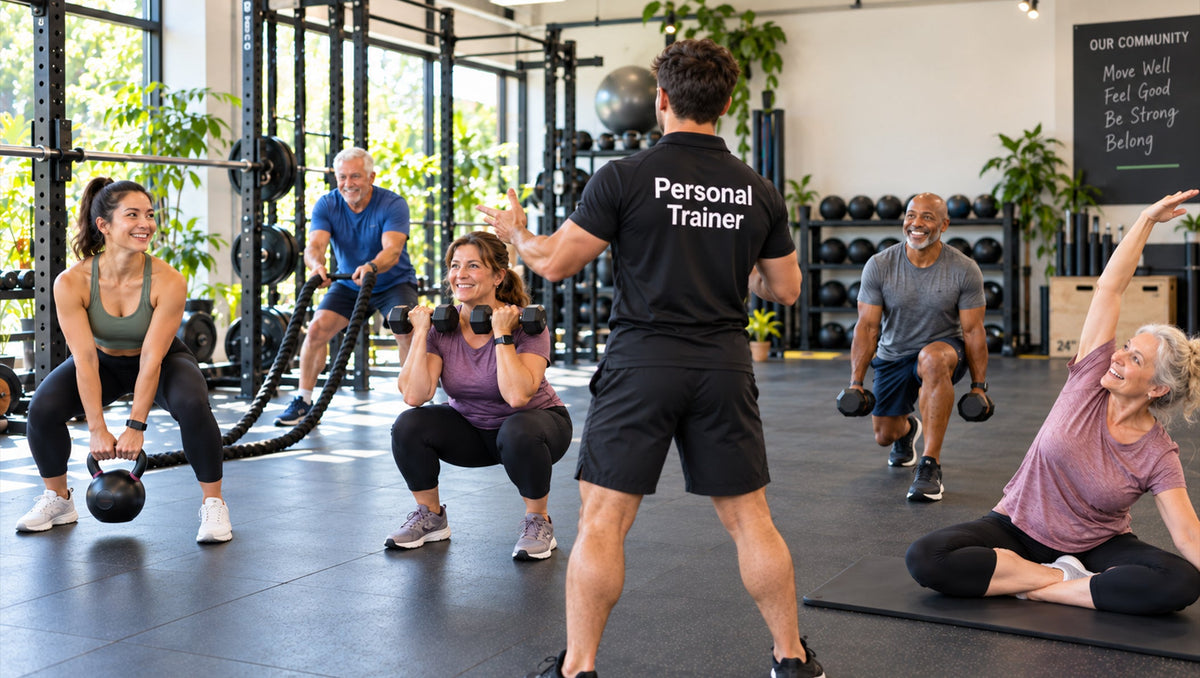
For those with little time, the answer may lie in shorter, more flexible training formats. For those lacking motivation, support, goal setting, feedback and community may play a crucial role. For someone who has never trained, the very experience of entering a gym, understanding equipment, and knowing where to start can be a barrier.
This requires fitness spaces to also consider the experience from the perspective of those who are not yet part of the sector.
Some questions become particularly important:
👉 Time: does a workout need to take an hour to be perceived as valid, or can there be shorter, easier formats to fit into a routine?
👉 Motivation: what happens after signing up? Is there support and a reason to return?
👉 Experience: is a space designed for long-time exercisers equally easy to use for someone just starting?
👉 Variety: are there different ways to train that can address various goals, ages, and motivations?
👉 Community: can a sense of belonging help turn an individual intention into a habit?
The question therefore goes beyond just “how do we get more sign-ups?”.
It also involves asking:
“What do we need to change so that someone who doesn't train today can start and find reasons to continue?”💡
Because there is an important difference between giving access to exercise and making it truly accessible in everyday life.
Youth show Portugal can have a different relationship with exercise
But the 68% also hide important generational differences.
Young Portuguese people exercise significantly more.
Among those aged 15 to 24, 85% of boys and 63% of girls say they practice sports. Looking at older generations, the scenario almost reverses: among men over 75, 95% say they never exercise, and among women in the same age group, it's 86%.
This means the relationship with exercise is not equally distant across all generations.
There is a young population significantly closer to sports. And this fact can be as important for the sector's future as the 68% figure itself.
Because the question stops being only how to get more young people to train.
It becomes: how to ensure that the young people training today continue to be active in 10, 20 or 30 years?
The challenge is not just to start. It is to continue throughout life. 🏃
The transition to professional life, increased responsibilities, parenthood, and aging change availability, goals, and what each person seeks from exercise.
And if lack of time already appears as one of the main barriers identified by the Portuguese, these transitions help understand why it is so important to view physical activity with a perspective of continuity.
The young person who today seeks intensity and longer training sessions may, years later, need 30-minute sessions that fit between work and family.
Later, they may start valuing other goals such as strength, mobility, recovery, personalized support, or maintaining autonomy.
The solution is not necessarily to make someone train the same way throughout their life.
It is about ensuring that there are relevant ways to keep training at every stage of life.
And this represents an important opportunity for fitness spaces: diversifying modalities, equipment, formats, and experiences to accompany not only different types of users but also the evolution of the same user over the years.
From access to adherence: what these data say to the fitness sector?
When we combine these conclusions, the Portuguese portrait becomes more complex than the last position in the European ranking might suggest.
Portugal still has very low activity levels. But it is improving, there is high awareness of the benefits of physical activity, and there is a young generation significantly closer to sports.
For gyms, clubs, studios, and professionals, this opens two fronts.
The first is reaching the huge population that still does not train, aiming to reduce entry barriers related to time, motivation, support, or the very experience of training.
The second is not losing those who already train, accompanying changes in needs and routines over life.
The sector's growth may, therefore, not depend solely on competing for the same practitioners among different spaces. There is a much larger population still outside this universe.
❓ How to make the first workout less intimidating? How to fit exercise into a schedule with little time? How to maintain motivation after the first weeks? How to adapt the experience when needs change? And how to prevent today’s active youth from becoming tomorrow’s inactive adults?
The 68% show the scale of the problem. The younger generation shows that the scenario does not have to stay this way. The challenge for the sector is to create conditions so that starting is easier and continuing makes sense at every stage of life.