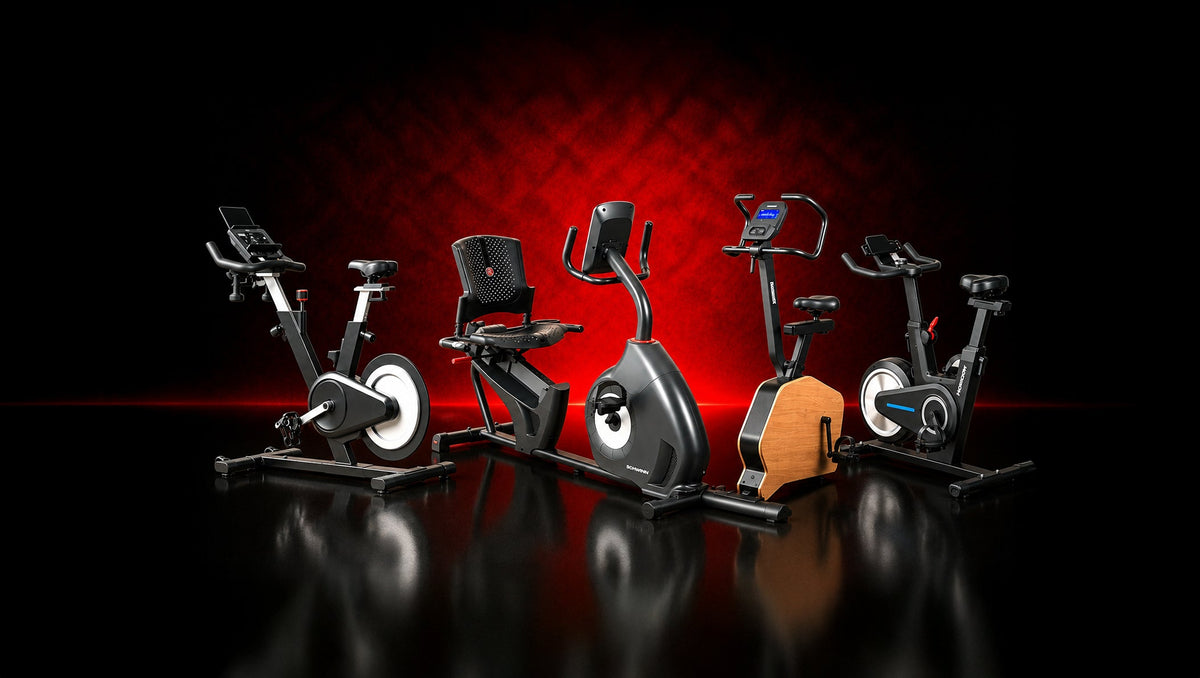
Choosing a bike for a cardio area is not just about comparing models, prices, or technical features. ✍️
An Air Bike, an Indoor Cycle, and an upright bike can all work the cardiovascular system, but they offer different training experiences and meet distinct goals. ❗ The intended intensity, user profile, type of training, and the usage context should therefore be part of the decision.
At BOOMFIT Marketplace, we gather solutions from brands such as Schwinn, Horizon Fitness, BODYTONE and Bowflex, enabling you to find different options for gyms, studios, clubs, and other training spaces.
But which makes more sense in each situation❓
Before choosing a bike, start with the training goal
❗ Different goals require different equipment features.
If the priority is to create short and high-intensity sessions, the choice will differ from that of a space seeking to provide indoor cycling sessions or offer a more conventional cardio option accessible to various user profiles.
That’s precisely why there isn’t a single answer to the question “What is the best cardio bike?”. Instead, there is equipment more suited to the type of use you want to create.
💨 Air Bike: for boosting intensity
Air Bikes stand out mainly because the resistance follows the user’s effort: the greater the effort, the greater the resistance.
This feature makes them particularly interesting for sessions aimed at quickly raising intensity and working with varying levels of effort.
They are an option to consider for:
✅ HIIT workouts;
✅ High-intensity intervals;
✅ Conditioning blocks;
✅ Explosive training;
✅ Functional circuits;
✅ Spaces where different users need to naturally adjust intensity to their level.
Instead of setting fixed resistance and maintaining the same pace, the effort itself influences the exercise's demand. This allows the Air Bike to be used both in short, intense bursts and in more controlled work blocks.
When does it make more sense? When intensity and conditioning are important components of the training program.
Indoor Cycle: to bring the cycling rhythm to training
When the goal is to provide an experience closer to indoor cycling, the Indoor Cycles come into play.
These machines are designed for a dynamic pedaling and greater intensity control throughout the session, allowing effort to be adapted to different training moments.
They may be suitable for:
✅ Indoor cycling classes and sessions;
✅ More intense cardiovascular training;
✅ Interval training;
✅ Individual sessions focused on performance;
✅ Spaces aiming to offer a more sportive pedaling experience.
For gyms and studios, these can also play a different role compared to other cardio machines, especially when there is a specific cycling program or when this type of training is part of the space’s offering.
When does it make more sense? When looking for a more dynamic cycling experience with greater focus on rhythm and intensity control.
Upright Bike: for consistent cardiovascular work
Not all users seek high-intensity workouts.
Upright bikes cater to a more traditional use of cardio equipment, offering a familiar training position and an experience easily adaptable to different paces and user levels.
They are particularly relevant for:
✅ Continuous cardiovascular work;
✅ Moderate intensity sessions;
✅ Warm-ups;
✅ Users with different experience levels;
✅ Cardio zones aimed at more diverse audiences.
✅ In a gym, hotel, or training space with varied user profiles, this versatility can be especially important.
When does it make more sense? When the priority is to offer a consistent, comfortable cardio solution adaptable to different usage levels.
Air Bike vs. Indoor Cycle vs. Upright Bike
Although belonging to the same large family of cardio equipment, the three options do not exactly perform the same role.
| Air Bike | Indoor Cycle | Upright Bike | |
|---|---|---|---|
| Main focus | Intensity and conditioning | Cycling and intensity control | Consistent cardio |
| Type of training | HIIT, intervals, circuits | Cycling, intervals, cardio | Continuous cardio, warm-up |
| Experience | Effort determines resistance | Pedaling oriented to rhythm and performance | More conventional pedaling |
| Usage | Short to moderate sessions, often intense | Individual sessions or classes | Sessions of varying durations |
| Contexts | Boxes, gyms, functional and performance training | Gyms, studios, and cycling zones | Gyms, hotels, and cardio zones |
The choice, therefore, depends less on finding a bike that does “everything” and more on understanding what role the equipment will play within the space.
Is it necessary to choose only one type of bike?
Not necessarily.
In a professional space, different bikes can be complementary.
An Air Bike can be part of the functional or conditioning training area, while Indoor Cycles can cater to specific cycling sessions and upright bikes reinforce a cardio zone aimed at broader use.
So, when planning equipment, it’s worth looking at the space as a whole and asking some questions:
👉 Who will use the equipment?
👉 What type of training do we want to offer?
👉 What is the average experience level of the users?
👉 Are we looking for intensity, cycling, continuous cardio, or a combination?
👉 How many users might need the equipment simultaneously?
👉 In which area of the space will it make most sense to integrate each bike?
These answers help define not only which bike to choose but also what combination of equipment best meets the real needs of the space.
👉 Discover the Indoor Bikes available at BOOMFIT Marketplace.
FAQs
What is the difference between an Air Bike and an Indoor Cycle?
The main difference lies in the experience and the type of resistance. On an Air Bike, resistance increases with effort, favoring high-intensity and conditioning workouts. An Indoor Cycle is more focused on the cycling experience and intensity control throughout the session.
Is an Air Bike suitable for HIIT?
Yes. Its ability to increase resistance based on effort makes this type of equipment particularly suitable for intense intervals and conditioning blocks.
Which bike to choose for a cardio zone?
It depends on the users and the space’s goal. For a more general use and continuous cardio, an upright bike may make sense. For cycling, an Indoor Cycle is more appropriate. For intensity and conditioning work, an Air Bike offers a distinct experience.
Can a gym have all three types of bikes?
Yes. The three types can serve different functions within the same space and complement each other in the training offer.