In a Pilates class, the same exercise can present different challenges to each student. While one is still trying to control the movement, another can already perform it easily. For the instructor, the key is understanding how to adapt the session and provide each person with an appropriate stimulus.
Pilates accessories can help in this task. A weight in the hands, an elastic band, or a ball allow you to explore variations, but each tool must have a clear function in the exercise.
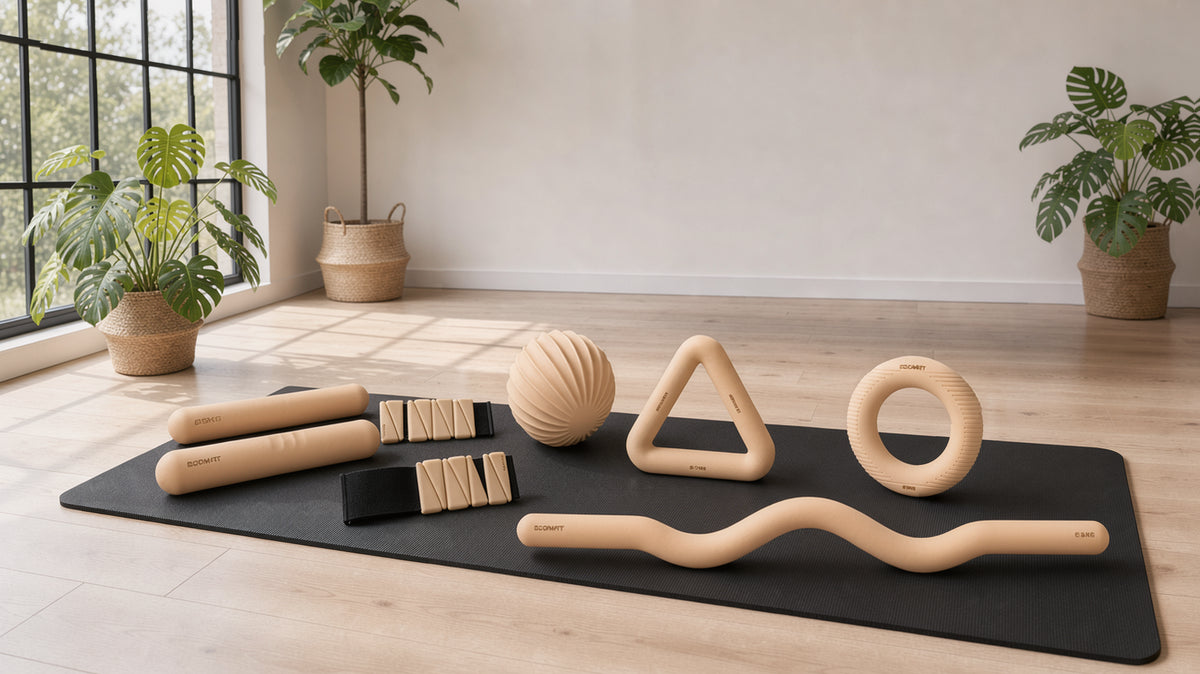
It is in this context that the BOOMFIT beige collection complements the studio equipment, with dumbbells, ankle and wrist weights, and other forms of load. To choose the right pieces, it is important to understand what they add to the session and how they fit into working with the students.
What can accessories add to Pilates classes?
Small accessories, also known as props, can serve to add resistance, offer support, or give the student a reference that facilitates the execution. The function depends on the equipment and how it is used.
The National Pilates Certification Program highlights these possibilities precisely and recommends introducing accessories gradually, taking into account the concentration, control, and coordination required of the practitioner.
For those leading classes, this translates into a practical question: what do I intend to change in this exercise?
If the goal is to add resistance to an arm movement, a weight may make sense. If the student needs support or a positioning reference, another accessory might be more suitable.
It is also not necessary to add material throughout the entire session. A well-chosen variation can be enough to explore a goal without making transitions between exercises too long.
Dumbbells for Pilates: a way to add load in the hands
Dumbbells allow adding resistance to selected arm movements. Their integration into Pilates should accompany the exercise’s objective, the student's capacity, and trunk control during execution.
The use of small weights is part of STOTT PILATES training proposals, which explore their application in specific mat exercises to add resistance and challenge stabilization. This framework depends on the selection of movements and instructor corrections.
BOOMFIT Silicone Dumbbells are available in pairs of 1, 1.5, 2, and 2.5 kg each, with a silicone coating.
Which weight to choose for a class?
The appropriate weight depends on the movement. A student might control a certain load with elbows close to the body and need less weight when the arms move away from the torso.
Therefore, equipping a class with a single weight for everyone limits adaptation options. Having different loads allows the instructor to adjust the exercise, including the possibility of performing it without weight.
During the session, observe if the load alters the intended execution: is there swaying, shoulders rising, or does the student lose the positioning they were trying to maintain? These signs help decide whether to reduce the load or revise the variation.
Ankle and wrist weights: resistance with free hands
Wearable weights have a practical difference compared to dumbbells: they allow adding load without requiring a continuous grip.
BOOMFIT Ankle and Wrist Weights are sold in pairs of 2 × 0.45 kg or 2 × 0.92 kg. The brand presents them to complement Pilates, strength, and muscular endurance exercises.
The choice between wearable weights and dumbbells should start with the accessory’s position and the planned movement. Holding a load in the hand and fixing it to the wrist are different experiences; the same applies when adding weight near the ankle.
Before introducing these accessories in a class, confirm their adjustment and try the transition between positions. The equipment should stay stable and allow the student to focus on execution.
Weighted ring and triangle: other grip options
For complementary strengthening exercises, the shape of the load also matters. It can change how to hold it, the distance between the hands, and the available space during the movement.
The BOOMFIT Silicone Ring is made of iron coated with silicone and is available in 2.5, 3.5, 4.5, and 6.8 kg. The Silicone Triangle uses the same materials, with versions of 3.15 and 4.5 kg.
These are shapes to consider when the instructor looks for an external load with a different grip. The choice should accompany the exercise and the student's comfort holding the piece.
Is the weighted ring the same as the Pilates ring?
This distinction is important before purchasing equipment for classes.
The flexible Pilates ring, often called Magic Circle, offers resistance when compressed. The Silicone Ring in this collection works as a weight shaped in a circle. You can check examples of flexible rings at Balanced Body.
If the exercise requires compression between the hands or legs, you need a ring designed for that function. The weighted ring serves a different type of use.
Silicone bar and Grip Ball: when to consider these pieces?
Not all products in a collection have to be part of the same class. Some pieces can be more useful in individual sessions or in physical preparation blocks that complement Pilates work.
The BOOMFIT Silicone Bar is available in 6.8 and 11.3 kg. These loads require their own evaluation and might make sense for certain two-handed strength exercises.
The BOOMFIT Grip Ball weighs 1.5 kg and has an 8.5 cm diameter, intended for grip, hand, wrist, and forearm work. It is a weighted ball, different from the soft inflatable balls usually used in Pilates.
For the studio, the question is whether these pieces meet a real need in the services provided. A space combining Pilates and personalized training may have different uses than a room dedicated exclusively to mat classes.
How to choose equipment for a Pilates studio?
Before determining quantities, look at how the classes function: how many students participate, which accessories are already used, and in which exercises you feel a lack of options?
From there, organize the purchase around four criteria:
- Session function: which exercise or adaptation justifies the accessory?
- Resistance variety: are there options for students with different abilities?
- Use between exercises: is it easy to put on, take off, distribute, and store?
- Space and maintenance: is there suitable storage and a cleaning procedure compatible with the equipment?
A class of eight people, for example, may need more than eight pairs of dumbbells if the goal is to allow choice among loads. The number of students defines part of the purchase; the alternatives you want to offer define the rest.
The Pilates Association Australia emphasizes that the use of accessories should have an identifiable purpose in the session. For those equipping a studio, this is also a useful investment criterion.
A collection that complements Pilates material
The BOOMFIT beige collection brings together different ways to add load to training, with a common visual presentation. For studios that value space coherence, the color allows combining pieces with the rest of the equipment.
The choice can start with the accessories that will be most frequently used in classes and evolve as the service grows. Dumbbells and wearable weights can respond to certain variations; ring, triangle, bar, and Grip Ball should be evaluated according to the available exercises and guidance.
Discover BOOMFIT Pilates equipment and select the accessories that make sense for your students, your sessions, and your space.
Choose the accessories for your sessions
Select the weight of each piece and add the desired quantity to the cart. Dumbbells and ankle and wrist weights are sold in pairs.


Frequently asked questions about Pilates accessories
What are Pilates accessories used for?
Accessories can add resistance, offer support, or provide references for execution. Their function depends on the exercise and the instructor's guidance. Not all accessories serve to make the movement more difficult.
Is it possible to use dumbbells in Pilates classes?
Yes. Small weights can be integrated into selected Pilates exercises, according to the instructor's approach and the student's capacity. The load must allow maintaining control and the movement's objective.
What is the recommended weight for Pilates dumbbells?
There is no single weight suitable for all people or exercises. The choice depends on the movement, the student's experience, and the execution observed by the instructor. In a class, offering different loads facilitates adaptation.
Are ankle and wrist weights sold in pairs?
Yes. In this BOOMFIT collection, pairs of 0.45 kg or 0.92 kg per unit are available. Each set includes two equal weights.
What is the difference between the Pilates ring and the weighted ring?
The Pilates ring is flexible and offers resistance to compression. The weighted ring acts as an external load. The choice depends on whether the exercise requires compressing a circle or moving and controlling a weight.
Does the Grip Ball replace a Pilates Soft Ball?
They are accessories with different functions. The BOOMFIT Grip Ball is a 1.5 kg weighted ball intended for grip work. The Soft Ball is a soft inflatable ball used in various Pilates exercises.
Is it necessary to buy the complete collection to equip a studio?
Purchasing should follow the classes and services of the space. Start with accessories expected to be used, ensure resistance options for the students, and add other pieces when there is a concrete need.