

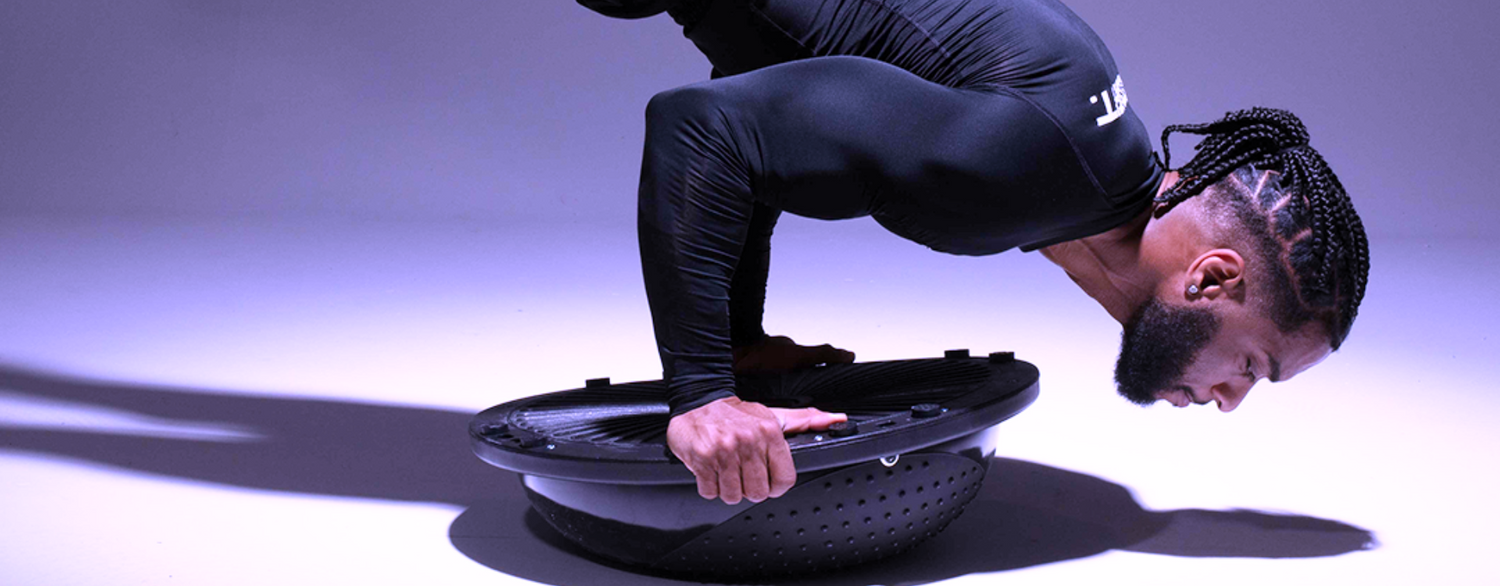
Personalizing a Training Plan is something that should always be present in the profession of a Personal Trainer. Therefore, enriching exercise routines should be a constant, bringing novelty to the workout while creating a feeling of exclusivity for those practicing it.
An excellent example of this is the introduction of new equipment into the training program.
In this article, we will talk about the “Bosu,” also known as the “Balance Station.” After all, this equipment is an excellent and fitting addition to a highly effective Training Program. For this, it is essential that Personal Trainers understand its features, benefits, and the best ways to use it, ensuring a safe and effective workout.
What Do We Train With the “Bosu”?
The “Bosu” (or “Balance Station”) is designed to activate muscles that are often neglected in traditional exercises. This added benefit helps improve joint stability and prevent injuries.
The versatility of the “Bosu” allows for a variety of exercise options: placed with the flat base on the floor or the dome side up, this equipment lets you work different parts of the body and adapts to various skill levels. The instability of this equipment forces the muscles of the feet and ankles to work harder, resulting in greater strength and flexibility. Some also use the “Bosu” for high-intensity exercises, making it an excellent option for cardiovascular training.
With a diameter of just 60 cm, the Balance Station is compact and easy to handle. The air pump for inflation and the resistance bands with handles further expand exercise and training options.
How to Structure a Workout With the “Bosu”?
It seems simple, but it can be a challenge.
We suggest a routine to all Personal Trainers that they can implement, structured around three phases: Warm-Up, Main Workout, and Stretching.
👉 Warm-Up (10 minutes)
This first phase can start with shoulder and hip rotation movements on the “Bosu,” followed by balance exercises where the athlete stands with one foot on the Bosu to activate stabilizing muscles.
👉 Main Workout (30 minutes)
- Squats with the “Bosu”: Place the base of the “Bosu” on the ground and perform squats, ensuring the knees do not go beyond the toes. (3 sets of 12-15 repetitions)
- Push-ups with feet on the “Bosu”: With feet on the “Bosu” and hands on the floor, perform push-ups while maintaining stability. (3 sets of 8-10 repetitions)
- Burpees on the “Bosu”: Start standing with feet shoulder-width apart. Place the “Bosu” flat side down firmly on the floor. (3 sets of 8-10 repetitions)
- Plank with feet on the “Bosu”: Place feet on the “Bosu” and hold the plank position, ensuring the body is aligned. (3 sets of 30-60 seconds)
👉 Stretching (10 minutes)
During this phase, the focus should be on the areas worked throughout the training, such as legs, back, and shoulders:
- Legs - Stretching the leg muscles like quadriceps, hamstrings, and calves helps improve flexibility and reduce muscle tension.
- Back - Stretching the back can relieve tension built up during the workout and prevent pain.
- Shoulders - Stretching the shoulders is crucial to maintain range of motion and prevent injuries.
Final Considerations
Incorporating the “Bosu (or “Balance Station”) in training programs is an effective way to diversify routines and provide a challenge that improves strength, balance, and endurance. By including the “Bosu,” the Personal Trainer is not only "offering" more exercises but also demonstrating technical knowledge that can boost the athlete’s performance.
Using equipment like the “Bosu” can be a differentiator that will enhance the quality of workouts and also solidify the professional’s reputation in the market.
BOOMFIT can be your partner in this goal, offering the best equipment to energize and diversify your portfolio. Get in touch with us!
Happy training!


